
Key Takeaways
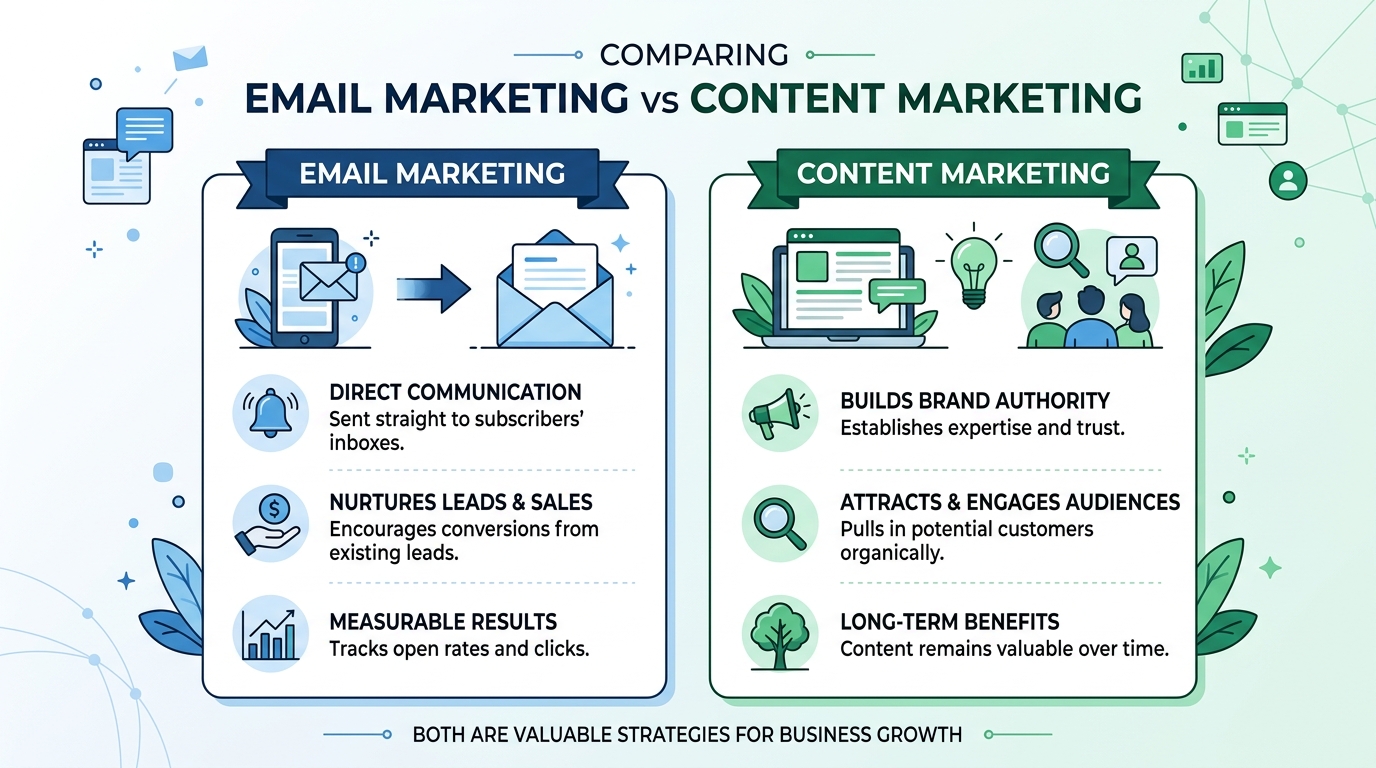
- Email marketing and content marketing generate leads through different mechanisms, with content attracting researchers and email nurturing opted-in subscribers toward action.
- Opt-in subscribers tend to convert faster because joining a list already signals genuine interest, unlike random website visitors.
- Public resources such as in-depth guides, case studies, webinars and video tutorials can attract prospects who are still searching for answers.
- Find out further down why measuring email success by opens and clicks alone can give a misleading picture of lead quality.
- A coordinated approach works well when content is used to attract an audience and email is used to nurture that audience toward becoming customers.
For an e-commerce business marketing manager juggling limited time and an even tighter budget, the question of where to put effort often comes down to two familiar options: email marketing and content marketing. Both are built to generate leads, yet they work in almost opposite directions. One reaches people who have already said yes to hearing from the business; the other reaches people who have never heard of it yet but are actively looking for help.
Two Channels, Two Lead Paths
Email marketing is a permission-based channel. It reaches people who have opted in, which supports direct communication and follow-up with an audience that has already shown interest. Content marketing, by contrast, uses public resources such as articles, videos, guides and case studies to attract people who are searching for answers, often before they know a particular business exists.
A breakdown of email marketing and content marketing for lead generation by the experts at AmpiFire contrasts email’s potential for quicker responses with content’s longer-term audience and traffic building. Understanding that contrast matters because it shapes where a small team should spend its limited hours each week. Get the balance right, and the two channels start feeding each other instead of competing for attention.
Email Marketing: Converting Those Already Interested
Email remains one of the most direct ways to speak to people who already know a brand. There is no algorithm deciding who sees the message and no competing headlines fighting for attention in a crowded feed; the message lands in a private inbox that the recipient chose to open up.
Why Opt-In Subscribers Convert Faster
When someone joins an email list, they have already crossed an important threshold in their buying process. That person has handed over their contact details voluntarily, which is a clear signal of genuine interest rather than passive curiosity. This self-qualification is precisely why opt-in subscribers tend to convert at a noticeably higher rate than random website visitors or social media followers, who may have arrived by accident or simple scrolling.
This pattern also explains why renting or buying email lists rarely pays off. A list built through permission carries trust from the very first send; a purchased list carries none of it, and recipients are quick to mark unfamiliar senders as spam. The UK’s Direct Marketing Association’s 2024 benchmarking figures put the average B2B email open rate at 35.9%, a reflection of the health of properly maintained, permission-based lists rather than cold outreach.
Five Campaign Types That Generate Leads
Not every email does the same job. Certain formats consistently perform better than a generic newsletter blast when the goal is generating leads:
- Welcome sequences: new subscribers are at their most engaged, so a short series introducing the brand and guiding them toward a first action tends to outperform standard updates.
- Educational autoresponders: sequential emails that deliver bite-sized expertise build trust gradually while quietly positioning a product or service as the solution.
- Abandoned cart or process recovery: following up with people who started but did not finish a sign-up or purchase can recover opportunities that would otherwise disappear.
- Special offers and time-limited promotions: creating urgency through deadlines or countdown timers tends to drive faster action than open-ended discounts.
- Re-engagement campaigns: inactive subscribers still hold value, and a well-crafted sequence can turn dormant contacts back into active prospects.
Measuring Success Beyond Opens and Clicks
Open rates and click rates are easy to track, but they only tell part of the story. A message can be opened and clicked without ever leading to a genuine enquiry or sale, so relying on those two figures alone risks celebrating activity that goes nowhere.
A more useful measure is conversion rate: the share of recipients who complete a meaningful action, such as booking a consultation or starting a trial. Pairing that with lead-quality indicators, like sales qualification rate and average deal size, reveals whether a campaign is attracting the right prospects rather than simply generating noise. Looking at how different subscriber segments respond to various campaign types over time adds a further layer, helping a marketing manager refine entire nurture sequences instead of tweaking single emails in isolation.
Content Marketing: Attracting People Who Are Searching
Where email speaks to people already inside the fold, content marketing is designed to bring new people in. It works by answering questions publicly, long before the person asking is ready to hand over their email address or make a purchase.
Public Resources That Pull In Prospects
Content marketing uses public resources such as articles, videos, guides and case studies to attract people seeking answers. Someone researching a problem is far more likely to land on a helpful explainer than on a sales page, simply because search engines and social platforms reward genuinely useful information over promotional messaging.
This is also why content marketing tends to filter for higher-quality leads over time. A visitor who finds a brand through a thorough guide arrives already informed and closer to a decision, which shortens the sales conversation considerably compared with someone who clicked a cold advert. The Content Marketing Institute’s 2025 B2B study found that 74% of marketers said content marketing helped generate demand and leads, underlining how central this approach has become to modern lead generation.
Formats That Turn Visitors Into Leads
Not all content performs equally. The source material behind this comparison identifies in-depth guides, case studies, webinars and video tutorials as formats that can support lead generation particularly well.
- In-depth guides solve a specific problem thoroughly, which makes them a natural fit for exchanging valuable information for a visitor’s contact details.
- Case studies and success stories show a solution working in practice, bridging the gap between simple education and an actual buying decision.
- Webinars combine live engagement with direct interaction, useful for anything that benefits from demonstration.
- Video tutorials achieve a similar effect for visual or hands-on products and services.
Thought leadership content deserves a mention too. It may convert more slowly than a straightforward how-to guide, but the leads it attracts tend to be more valuable, since trust built over repeated, useful insights often outweighs a lower price elsewhere.
Where the Two Strategies Overlap
Despite pulling in different directions, email and content marketing share more common ground than their surface differences suggest. Recognising that overlap helps a small team avoid treating them as entirely separate projects requiring separate skill sets.
Both Depend on Useful, Relevant Information
Both approaches depend on useful, relevant information rather than pure promotion. Purely promotional messaging, whether in an inbox or on a blog, tends to be ignored or unsubscribed from quickly. Content that genuinely helps the reader solve a problem, make a decision or understand a topic consistently earns more attention than material built solely to sell.
Both Need Audience Understanding and Testing
Deep audience knowledge is essential to success in both channels. Clear buyer personas, informed by real research into challenges and goals, allow a marketing manager to write content and emails that connect authentically rather than guess at what might land. Ongoing measurement and testing matter equally on both sides too; testing a subject line works on the same principle as comparing conversion rates between two content formats, and both disciplines reward a habit of small, continuous experiments over big, infrequent overhauls.
Building a Coordinated Lead Strategy
Treating email and content as competing priorities often wastes the strengths of both. The more productive approach treats them as two stages of the same process, each covering ground the other cannot reach alone.
Content Attracts, Email Nurtures
Content marketing does the work of attracting visitors who do not yet know a brand exists; email marketing then nurtures those visitors toward becoming customers. A visitor who discovers a helpful guide and signs up for updates has effectively moved from a public, anonymous audience into a private, permission-based relationship, which is exactly where email’s strengths take over.
This is also where many e-commerce businesses run into a quiet limitation: content only works if people actually find it, and email only reaches whoever is already on the list. A single blog post sitting on one website, or a video sitting on one platform, competes with thousands of others and risks staying invisible to most of the people searching for it. Showing up across multiple channels, such as search, video, audio, social and news, gives content a far better chance of being the resource someone finds first, which in turn keeps the email list growing with people who already recognise the brand.
Together They Complete the Lead Generation Process
Content marketing and email marketing are two halves of one lead generation process rather than rivals competing for the same budget line. Content does the heavy lifting of attraction, meeting people while they are still researching and forming opinions. Email then takes over once interest is established, nurturing that relationship with timely, relevant messages until a prospect is ready to act.
For a digital marketing manager with limited hours in the week, the practical answer is rarely “choose one.” The goal is building a simple system where useful public content keeps bringing new people in, and a well-segmented, permission-based email list keeps those people engaged until they are ready to buy. Getting both working together, rather than treating them as separate projects, tends to be the difference between sporadic results and a steady, compounding stream of lead generation strategies that keep paying off over time.
AmpiFire
support@ampifire.com
London Office 15 Harwood Road, , London, England United Kingdom
London
England
SW6 4QP
United Kingdom


