
Hangzhou City, Zhejiang Province, China-October 15, 2026
Efficient bulk cargo loading is an important part of modern port operations. For terminals handling large quantities of coal, minerals, grain, cement, and other bulk materials, loading speed directly affects vessel turnaround time and overall terminal productivity.
A travelling ship loader provides a flexible solution by moving along the berth while loading cargo. Instead of requiring the vessel to move repeatedly to align different holds with a fixed loading point, the loading equipment can travel to the required position. This can help reduce unnecessary vessel movements and improve the efficiency of bulk cargo handling.
What Is a Travelling Ship Loader?
A travelling ship loader is a bulk material handling machine designed to load cargo from a conveyor system into vessels. Unlike a fixed ship loader, the main loading structure can move along rails or another travelling mechanism installed beside the berth.
During loading operations, the machine can move along the quay to reach different vessel holds. The boom can also be adjusted according to the vessel’s position and cargo requirements.
Travelling ship loaders are commonly used at ports, terminals, mines, power plants, grain facilities, and other locations where large volumes of bulk material need to be transferred efficiently.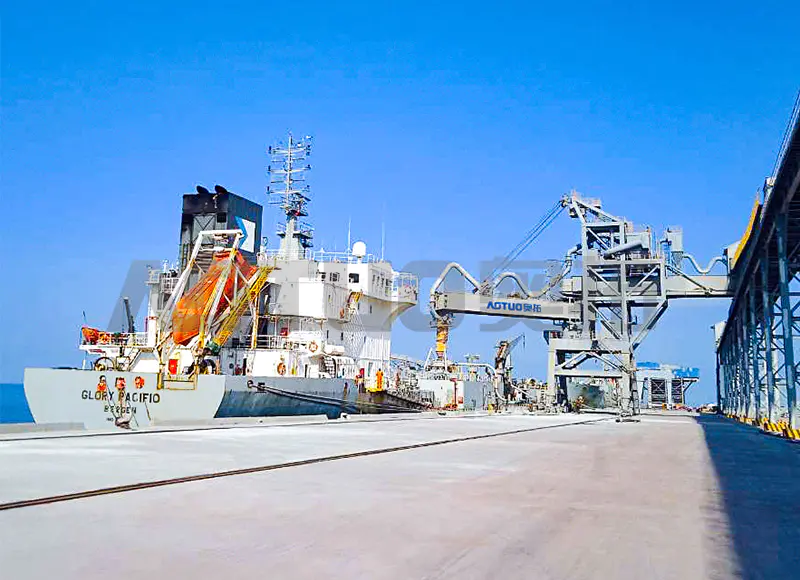
Key Features That Improve Loading Efficiency
Rail-Mounted Travelling System
One of the main advantages of a travelling ship loader is its ability to move along the berth. A rail-mounted system allows one machine to cover a relatively large operating area without requiring the vessel to reposition frequently.
This arrangement can improve berth utilization and make loading operations more flexible, particularly when different vessel sizes or loading plans need to be handled.
Adjustable Loading Boom
The loading boom can usually be adjusted through functions such as luffing, slewing, or telescopic movement. This allows the discharge point to be positioned over different areas of the vessel.
Accurate boom positioning can also help distribute bulk material more evenly inside the hold and reduce unnecessary material movement.
High-Capacity Conveyor System
The conveyor system is another important component of the ship loading process. A high-capacity conveyor can continuously transport material from the storage or transfer system to the loading boom.
Compared with intermittent loading methods, continuous conveying can provide a more stable material flow and support higher throughput.
Automated Control
Modern travelling ship loaders can integrate PLC control systems, sensors, position monitoring, and other automation technologies.
Automation helps operators monitor equipment movement, conveyor operation, boom position, and loading conditions. It can also reduce manual intervention and improve operational consistency.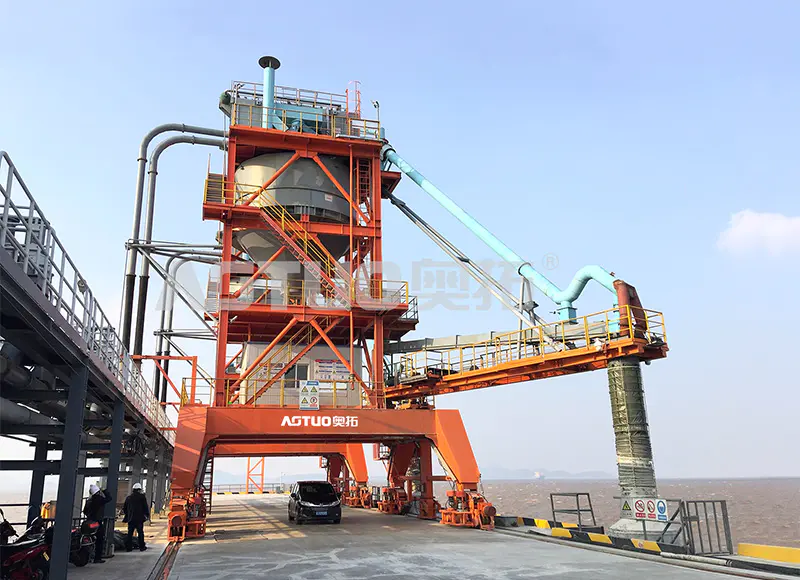
Travelling Ship Loader vs. Fixed Ship Loader
Travelling Ship Loader
A travelling ship loader is designed to move along the berth and serve different loading positions.
Its main advantages include:
• Larger berth coverage• Reduced vessel repositioning• Flexible loading positions• Better adaptability to different vessel sizes• Continuous bulk material handling
However, a travelling system may require a higher initial investment because of the travelling mechanism, rails, electrical systems, and supporting infrastructure.
Fixed Ship Loader
A fixed ship loader remains in one primary operating position.
It can be suitable for terminals where vessels and cargo handling requirements are relatively consistent. Its structure can be simpler, and installation requirements may be lower than those of a travelling system.
However, when different vessel holds need to be reached, the vessel may need to move along the berth. This can increase operational complexity and may result in additional vessel positioning time.
Applications Across Bulk Cargo Industries
Mining and Minerals
Travelling ship loaders are widely used for materials such as iron ore, bauxite, copper concentrate, and other mineral products.
These materials often require high-capacity conveying systems and wear-resistant components because of their weight and abrasive characteristics.
Coal and Energy
Coal terminals require reliable and continuous loading systems to handle large quantities of material.
Travelling ship loaders can help improve loading flexibility while working with conveyor systems designed for high throughput. Dust control can also be integrated into the loading system where required.
Grain and Agricultural Products
Grain products such as wheat, corn, soybeans, and other agricultural materials require careful handling to reduce product damage and material loss.
A controlled conveyor and loading system can provide a stable flow of material while allowing operators to adjust the loading position inside the vessel.
Cement and Construction Materials
Cement, clinker, aggregates, and similar materials are commonly transported in bulk.
Enclosed conveying systems and dust-control measures can help reduce material loss and improve the working environment during loading operations.
How to Select the Right Ship Loading System
Cargo Characteristics
The physical properties of the cargo should be considered first. Factors such as particle size, bulk density, moisture content, abrasiveness, and flowability can influence equipment selection.
Throughput Requirements
The required loading capacity is another important consideration. Terminals with high annual cargo volumes may need a high-capacity conveyor and ship loading system to achieve their required vessel turnaround times.
Berth Layout
The length and configuration of the berth should also be evaluated. A travelling ship loader needs sufficient space for rail movement and supporting infrastructure.
The number of loading positions and the range of vessel sizes expected at the terminal can also affect the equipment configuration.
Automation Level
Automation requirements depend on the terminal’s operating model. Basic systems may require more manual control, while advanced terminals can integrate sensors, PLC systems, remote monitoring, and automated positioning.
Choosing the appropriate automation level can help balance equipment investment with operational requirements.
Frequently Asked Questions
How much faster is a travelling ship loader than a fixed system?
The actual improvement depends on the terminal layout, vessel size, cargo type, conveyor capacity, and operating procedures. A travelling system can reduce the need for vessel repositioning, which may shorten certain loading operations.
What cargo capacity can a travelling ship loader handle?
The capacity depends on the equipment design, conveyor system, cargo characteristics, and terminal requirements. Different projects can be configured for different throughput levels.
Can one travelling ship loader handle different cargo types?
Yes. With the appropriate conveyor, boom, transfer, and dust-control configuration, a travelling ship loader can be designed for different types of bulk cargo. The material characteristics should be evaluated before selecting the equipment.
What vessel sizes can a travelling ship loader accommodate?
The suitable vessel size depends on the boom configuration, travelling range, loading height, berth design, and required operating envelope. Equipment should be designed according to the vessel dimensions and terminal conditions.
Conclusion
Travelling ship loaders provide a flexible approach to bulk cargo loading by combining continuous conveying with mobile loading capability. Their ability to move along the berth can reduce vessel repositioning requirements and allow a single loading system to serve multiple vessel holds.
For terminals handling large volumes of bulk materials, the combination of travelling mechanisms, adjustable booms, high-capacity conveyors, and automated control can contribute to more efficient cargo handling.
The right system should be selected according to cargo characteristics, required throughput, berth layout, vessel dimensions, and automation requirements. With proper equipment configuration, travelling ship loaders can become an important part of an efficient bulk material handling system.
About us
Hangzhou Aotuo Mechanical and Electrical Co., Ltd. (abbreviated as AOTUO), founded in 2003, is a Chinese high-tech enterprise specializing in comprehensive solutions for dry bulk material port transfer systems, as well as the R&D, manufacturing, and service of high-end dry bulk material port handling equipment.
Media Contact
Company Name: Hangzhou Aotuo Mechanical and Electrical Co., Ltd.
Contact Person: Media Relations
Email: Send Email
Country: China
Website: https://www.cnaotuo.com/
Press Release Distributed by ABNewswire.com
To view the original version on ABNewswire visit: Travelling Ship Loaders Improve Efficiency in Modern Bulk Cargo Loading Operations


