
Key Takeaways
- A watch rated to 30 ATM is built for serious underwater use at 300 meters, while a 30-meter watch offers only splash resistance.
- Water resistance ratings come from static pressure tests that don’t reflect the real-world conditions of actual swimming.
- Price is not a reliable indicator of water resistance; a less expensive fashion watch can carry a higher rating than a pricier specialty watch.
- The strongest indicator of serious water resistance is a screw-down crown, which creates a more secure seal.
- Vaiana Express found and corrected a data error in its own listings that misstated 30-meter watches as 30 ATM, showing how common this confusion is.
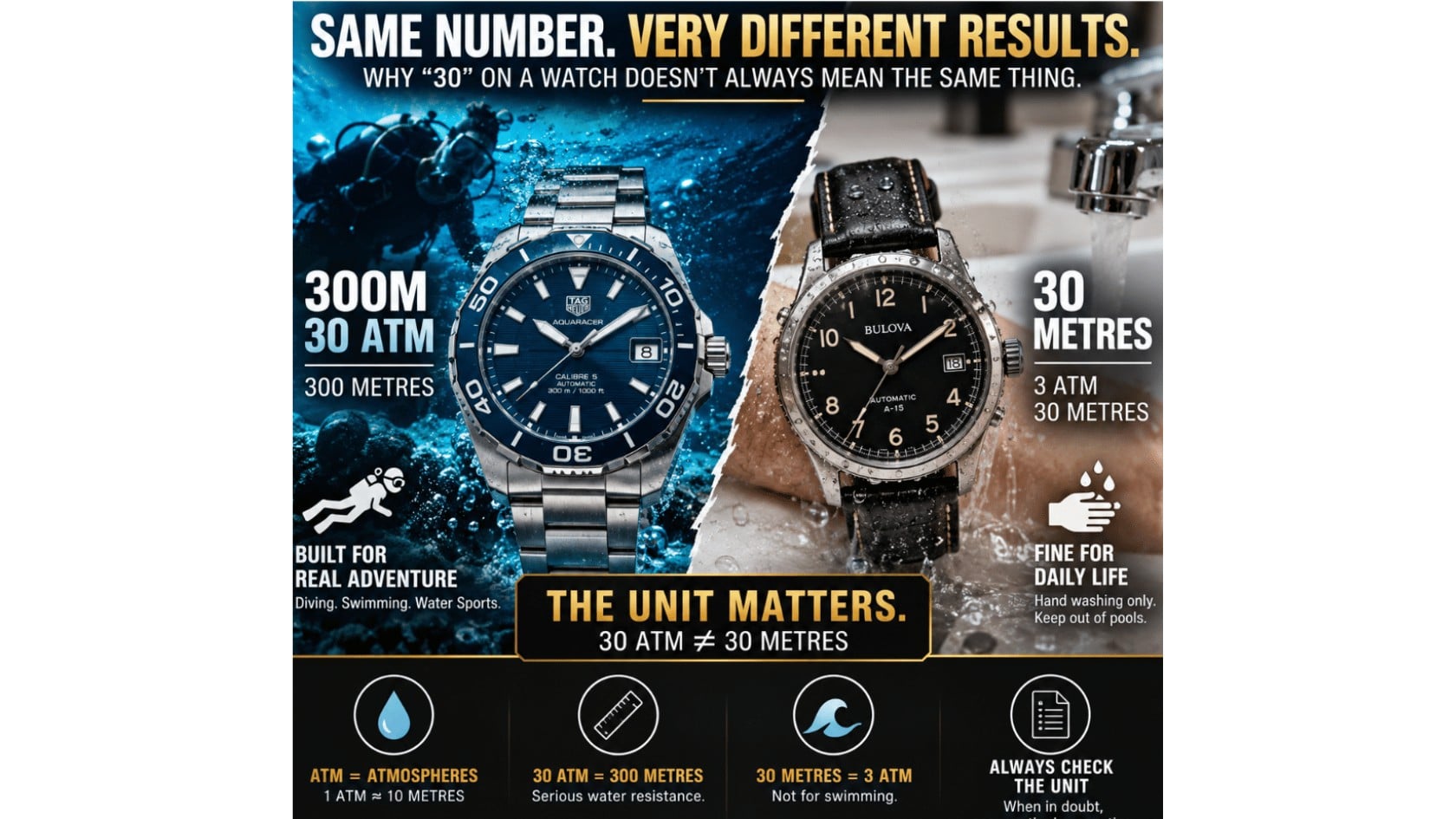
Two watches can both show the number “30” in their water-resistance rating. One is a professional watch built to survive 300 meters underwater, while the other shouldn’t be worn in a swimming pool. The key to understanding this tenfold difference lies in the unit of measurement used: ATM or meters. A watch’s water resistance is an important feature, but the way it’s presented on a spec sheet can be misleading if you don’t know how to read it. Understanding the terminology is the first step toward protecting your investment from water damage. For a closer look, Vaiana Express provides a detailed guide on what 30 ATM actually means and why it’s not 30 metres.
Two Watches, Both Rated “30”
The confusion starts with how different brands list their specifications. For example, a TAG Heuer Aquaracer might be rated “30 ATM,” while a Bulova A-15 Pilot watch is rated for “water resistance to 30 metres.” Both feature the number 30, but their capabilities in water are worlds apart.
The TAG Heuer is built for professional deep-sea use, while the elegant pilot’s watch is designed to handle accidental splashes at most. The difference is the unit. “ATM” stands for atmospheres, a measure of pressure, while “metres” refers to depth. This single distinction is the most common point of misunderstanding for watch buyers.
ATM to Meters: The Real Conversion
The relationship between atmospheres and meters is simple once you see it: one atmosphere of pressure equals the pressure exerted by roughly 10 meters of water. Multiply the ATM rating by 10 to get the approximate depth in meters.
Why 30 ATM Equals 300 Meters
Using this conversion, a watch rated for 30 ATM can withstand the pressure equivalent of being 300 meters deep. A watch rated for 30 meters, by contrast, is built to handle only 3 ATM of pressure. The number 30 appears in both specifications, yet one describes a watch with ten times the water resistance of the other. If a listing gives a number without a unit, the safest assumption is the lower value (meters) until you can confirm otherwise.
What Each Rating Actually Allows
A watch’s water resistance rating measures the static pressure it can endure in a lab, not a literal depth guarantee for real-world activities. Here is what the numbers mean in practical terms:
- 30 m / 3 ATM: Safe for rain, splashes, and washing hands. Not suitable for immersion in water.
- 50 m / 5 ATM: Can handle showering and brief, gentle surface swimming.
- 100 m / 10 ATM: Suitable for swimming, snorkeling, and other water sports.
Built for recreational scuba activities. Designed for serious, professional underwater activities.
Many are surprised to learn that a 30-meter rating isn’t enough for swimming. This gap between the number on the case back and its real-world application comes from the difference between static and active pressure.
Static Tests vs. Real-World Swimming
The rating printed on a watch comes from a static pressure test. In a controlled environment, the watch is subjected to a fixed amount of pressure without any movement. Real-world water activities involve constant movement and changing conditions.
Swinging your arms while swimming, plunging into a pool, or even the force from a jet in a hot tub can generate sudden spikes in pressure that far exceed the watch’s static rating. This is why a 30-meter watch is recommended only for light splashes. Manufacturers provide practical guidelines that account for the forces a watch experiences in daily life. Heat plays a role too; hot water from a shower can cause the watch’s gaskets to expand and contract, potentially compromising the seals.
The Guess Listing Error We Found and Fixed
While researching this topic, we audited the listings in our own catalog and found a significant error. Supplier data for the Guess watches included a field written as “ATM – 30,” where the number referred to meters. The system misinterpreted this as 30 ATM, leading to descriptions of 30-meter dress watches as if they were rated for 300 meters of depth.
The Guess Gala, a rose-gold watch measuring 30mm, was one of the affected models. It’s rated for 30 meters (splashes only), yet the listing implied it was a swimming watch. All 201 Guess watch listings were reviewed, and the 129 that contained this error were corrected. This mistake shows just how easy it is to misread these specifications, which is exactly the problem this guide sets out to solve.
Price Doesn’t Predict Water Resistance
It’s a common assumption that a more expensive watch will have better water resistance, but this often isn’t the case. A watch’s price is set by its movement, materials, brand heritage, and complications, while water resistance is a specific design feature.
For instance, the Bulova A-15 Pilot Automatic, a historically significant mechanical watch, costs nearly twice as much as a Michael Kors Runway chronograph. Yet the Michael Kors watch has a higher water resistance rating (50 meters) compared to the Bulova’s 30 meters. The Bulova is a specialized pilot’s watch where water resistance was never a primary design goal, while the quartz-powered Michael Kors fashion watch was built with a better-sealed case. Water resistance is a functional design choice, not a measure of overall quality or price.
Reading Any Spec Sheet in Seconds
You can quickly assess a watch’s true water resistance by looking for a few key indicators.
Spotting the Unit and the Screw-Down Crown
First, always find the unit: ATM, BAR (nearly identical to ATM), meters, or feet. If no unit is listed, be cautious. Next, compare the rating to the watch’s physical design. A thin dress watch is unlikely to be a 300-meter professional underwater watch, regardless of what a listing might claim. The single most important feature for serious water resistance is a screw-down crown, which creates a much tighter seal against the case than a standard push-pull crown.
How Water Resistance Fades Over Time
The water resistance rating on a new watch isn’t permanent. Over time, its ability to keep water out diminishes due to several factors.
Gaskets, Crowns, Pushers, and Heat
The rubber gaskets that seal the case back, crystal, and crown are the primary defense against water. These seals age, harden, and shrink, compromising the watch’s integrity. Forgetting to screw down the crown after setting the time leaves a direct path for water to enter the movement. Similarly, operating chronograph pushers while underwater can break the seal on most models. Heat from saunas or hot tubs can also damage gaskets, and a sharp impact can subtly warp the case, creating an opening for moisture. If you swim with your watch regularly, having its seals pressure-tested by a professional every couple of years is a wise precaution.
Two Identical Numbers, Ten Times the Difference
The number “30” on a watch’s water resistance specification can describe two vastly different capabilities. A 30 ATM rating signifies a 300-meter professional watch built for underwater use, while a 30-meter rating indicates a watch that should only be exposed to minor splashes. Understanding the difference between ATM and meters, static tests and real-world use, and the key features of a water-resistant design lets you make an informed choice.
To put this knowledge into practice, you can find several watches with clear and accurate water resistance ratings to suit any activity.
Vaiana Express
jerry@VaianaExpress.com
+1 929 322 8781
194 Woehrle Avenue
Staten Island
New York
10312
United States


