
Rumble Rims Wins 2026 U.S. James Dyson Award for Bringing Concussion Screening Out of the Clinic and Onto the Sideline
PR Newswire
BOSTON, Sept. 16, 2026
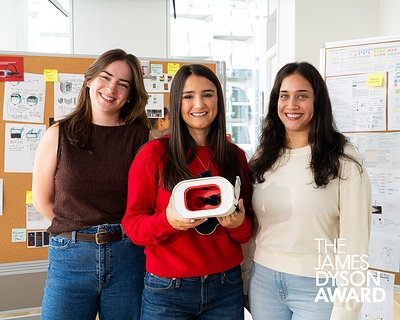
BOSTON, Sept. 16, 2026 /PRNewswire/ — Radhika Saran, Cleo Pontone, and Sophia DeVito, students at Harvard University, have been named the U.S. National Winners of the James Dyson Award 2026 for their invention, Rumble Rims. The low-cost infrared eye-tracking headset is designed to help schools screen for possible concussions in about 60 seconds, bringing objective neurological insight into the sideline moments where coaches, athletes, and families often need clarity most.
Concussions remain a major concern for young athletes. According to the CDC, about seven in 10 emergency department visits for sports- and recreation-related traumatic brain injuries and concussions are among children ages 17 and under, and contact sports account for approximately 45% of these visits among children.1 Separately, CDC analysis of the 2017 Youth Risk Behavior Survey found that 15.1% of U.S. high school students — approximately 2.5 million students — reported at least one concussion related to sports or physical activity in the prior 12 months.2 The CDC also advises that athletes with a suspected concussion should be removed from play immediately and kept out until cleared by a healthcare provider.3
The Invention: Rumble Rims
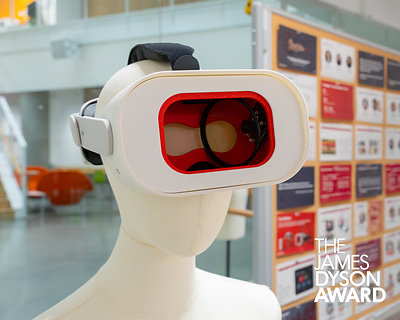
Rumble Rims was developed to close a gap in concussion care between expensive clinical systems and subjective sideline checks. The system combines a portable infrared headset, coach-facing display, and recovery dashboard to give schools a more accessible way to track eye movements that research suggests may provide an objective window into concussion-related neurological disruption.4
The headset uses infrared cameras and hot mirrors that reflect infrared light to the cameras while allowing visible light to pass through, preserving a clear line of sight for the athlete. During screening, the athlete completes an oculomotor task that captures how the eyes follow, fixate, and move. The coach-facing mobile display then translates complex eye-tracking measurements into real-time guidance that can help inform whether an athlete should be removed from play and referred for professional medical evaluation. After the game, the recovery dashboard allows repeat testing over time, creating an objective record that athletes, families, and clinicians can use to monitor progress before return-to-play. Rumble Rims is intended as a screening tool, not a diagnostic device; return-to-play decisions should remain under the direction of a qualified healthcare provider.3
The team’s research included conversations with coaches and Matthew McTague, a certified physical therapist and former collegiate athlete, whose feedback helped shape Rumble rims’ sideline-first design. McTague noted that concussion symptoms may not always appear when an athlete is tested at rest, but can emerge once heart rate, movement, balance, and eye tracking are challenged. His perspective highlighted the need for objective testing, since athletes in high-pressure situations may underreport symptoms. He recommended using tools like smooth pursuit eye tracking and real-world testing to improve evaluations.
Rumble Rims takes home $6,500 from the James Dyson Award national prize to support its next steps in development. The team plans to build and test a higher-fidelity headset prototype, refine the oculomotor test and validate the system with athletes, coaches, trainers and medical advisors. Long term, they hope to pilot Rumble Rims with schools and youth sports programs, pursue medical-device validation pathways and make objective concussion screening accessible to every sideline.
While the technology is still in development, its focus on objective eye-movement data responds to a clear clinical need: concussion assessment today still often depends on symptoms, history and clinical evaluation, while structural imaging is frequently normal and self-reporting can be incomplete.4
Radhika Saran, co-creator of Rumble Rims, said: “We wanted to give coaches, athletes and families clearer information at the exact moment of risk. If objective tools already exist, they should not be locked inside expensive clinical systems. They should be accessible where young athletes are actually getting injured.”
Cleo Pontone, co-creator of Rumble Rims, said: “We wanted to create something human-centered and research-driven. The strongest solutions start with understanding the people who will actually use them and the environments they will be used in.”
Sophia DeVito, co-creator of Rumble Rims, said: “The best solution for a problem might not sit inside one person’s expertise. That is why interdisciplinary collaboration was so important to this project.”
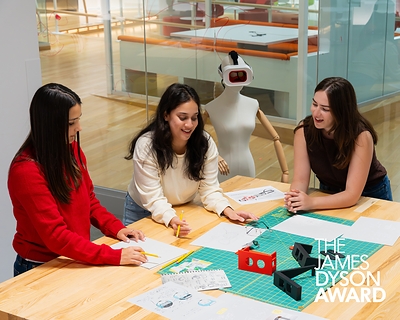
The team’s sideline-first design process was shaped by user research with athletes, coaches, medical professionals, and physical therapists. Early concepts explored helmets, mouthguards, a black-curtain room, and expandable structures that enclosed the screen, camera, and athlete’s face. Through testing, the team realized accuracy depended less on building a controlled room and more on controlling the relationship between the eyes and cameras, leading to a headset design that moves with the athlete’s head while keeping the screen separate and setup simple for coaches under sideline pressure.
Rumble Rims, alongside the two U.S. national runners-up, BiliRoo and Preta, will progress to the next stage of the James Dyson Award, with the international Top 20 shortlist to be announced on October 14th, selected by a global team of Dyson engineers, and the global winners on November 4th, chosen by James Dyson.
YouTube Link: Here
The Invention: BiliRoo
BiliRoo is a wearable phototherapy device designed to treat infant jaundice while allowing parents to hold their babies during care.
Problem: Jaundice affects many newborns, and one in 10 infants require clinical treatment. In limited-resource settings, more than six million infants each year lack access to treatment due to sporadic electricity, high equipment costs and limited trained personnel. Current phototherapy machines can also separate parents from their babies, limiting skin-to-skin contact during care.
Solution: BiliRoo turns phototherapy into a wearable infant sling, using a filter that blocks harmful UV radiation while allowing therapeutic blue light from the sun to pass through. The design aims to make jaundice treatment simpler, more accessible and compatible with kangaroo care, so babies can receive treatment while being held by a parent.
BiliRoo was submitted by Daniel John, a University of Michigan medical student who grew up in Nepal, where limited access to medical care, unreliable electricity and expensive medical devices shaped his interest in designing for limited-resource settings. Inspired by conversations with physicians in Nepal and sub-Saharan Africa, Daniel created BiliRoo to make jaundice treatment simpler, more affordable and easier for parents to use while staying close to their babies.
The Invention: Preta
Preta is a design material platform that transforms carbon-rich agricultural waste into high-performance materials for everyday products.
Problem: Agricultural waste is often discarded or burned, releasing carbon back into the atmosphere, while many carbon capture systems remain energy intensive and difficult to scale. Existing applications for solid carbon are often limited to additives or soil use, creating a need for more scalable, product-focused uses.
Solution: Preta rethinks captured carbon as a primary material component rather than a small additive, enabling high carbon infill while remaining compatible with existing manufacturing systems. The team is developing products and prototypes across applications including furniture, flexible leather-like materials and larger-scale architectural uses, with the goal of turning manufacturing into a pathway for carbon drawdown.
Preta was submitted by Hana Khurshid and Steffek Rainey, students from Harvard’s Design Engineering Program who bring backgrounds in architecture, sustainability, entrepreneurship, and environmental problem-solving. Driven by experiences with climate change, agricultural waste, pollution, and the challenge of making sustainable solutions desirable at scale, the team created Preta to turn carbon-rich waste into useful materials that can permanently store carbon in everyday products.
James Dyson Award
The James Dyson Award is an international design competition that inspires and celebrates the next generation of design engineers. Now in its 21st year, the Award has supported more than 400 problem-solving inventions with over $2.3m in prize money. It operates across 28 countries and regions and is run by the James Dyson Foundation, Sir James Dyson’s engineering-education charity.
James Dyson Foundation
The James Dyson Foundation, established in the UK in 2002, now supports design, technology and engineering education programmes not only in the UK but also in countries around the world, including the United States, Japan, Singapore, the Philippines and Malaysia. To date, James Dyson and the James Dyson Foundation have donated more than $210 million to charitable causes. This includes a $16 million donation to establish the Dyson School of Design Engineering at Imperial College London, an $11 million donation to support the creation of the Dyson Centre for Engineering Design and the James Dyson Building at the University of Cambridge and finally, a $10.5 million donation to fund Malmesbury Primary School’s STEAM Center and expansion project.
1 Sarmiento, K., Thomas, K. E., Daugherty, J., Waltzman, D., Haarbauer-Krupa, J. K., Peterson, A. B., Haileyesus, T., & Breiding, M. J. (2019). Emergency department visits for sports- and recreation-related traumatic brain injuries among children — United States, 2010–2016 . MMWR Morbidity and Mortality Weekly Report, 68(10), 237–242.
2 DePadilla, L., Miller, G. F., Jones, S. E., Peterson, A. B., & Breiding, M. J. (2018). Self-reported concussions from playing a sport or being physically active among high school students — United States, 2017 . MMWR Morbidity and Mortality Weekly Report, 67(24), 682–685.
3 Centers for Disease Control and Prevention. Responding to a sports-related concussion; and Centers for Disease Control and Prevention. Returning to sports. CDC HEADS UP.
4 Eye-movement and ocular biomarker research, including Murray et al. Smooth pursuit and saccades after sport-related concussion; and Carrick et al. The pupillary light reflex as a biomarker of concussion.
NOTES TO EDITORS
The James Dyson Award forms part of a wider commitment by Sir James Dyson, to demonstrate the power of engineers to solve the world’s problems. The competition has supported more than 400 inventions with prize money and a chance to gain global media exposure, and is run by the James Dyson Foundation. Founded in 2002, the Foundation is an international education charity whose mission is to inspire the next generation of engineers. The Foundation also invests in medical research and has donated over $200m to charitable causes to date.
ABOUT THE COMPETITION
The brief. Design something that solves a problem. This problem may be a frustration that we all face in daily life, or a global issue. The important thing is that the solution is effective and demonstrates considered design thinking. Unlike other competitions, participants are given full autonomy over their intellectual property.
The process. Entries are judged first at the national level by a panel of external judges and a Dyson engineer. Each operating market awards a national winner and two national runners-up. From these winners, a panel of Dyson engineers then select an international shortlist of 20 entries. The top 20 projects are then reviewed by Sir James Dyson, who selects his global winners.
The 2026 prizes
- Global winners, chosen by Sir James Dyson, each receive a prize of $35,000.
- Each national winner receives $6,500.
Previous global winners
- 2025 Medical Winner – OnCue
A smart, assistive keyboard for people with Parkinson’s
- 2025 Sustainability Winner – WaterSense
An autonomous water quality monitoring device.
- 2024 Medical Winner – Athena
A portable and affordable hair-loss prevention device for chemotherapy patients.
- 2024 Sustainability Winner – airXeed Radiosonde
A reusable, nature-inspired sensor to improve weather forecasting and tackle e-waste.
- 2023 International Winner – The Golden Capsule
A hands-free IV device for disaster zones.
- 2023 Sustainability Winner – E-COATING
A sustainable exterior wall coating with a high cooling effect, reducing environmental costs of air conditioning.
- 2023 Humanitarian Winner – The Life Chariot
An off-road trailer ambulance for universal towing.
- 2022 International Winner – SMARTHEAL
A smart sensor for dressings which indicates how well a wound is healing by measuring its pH level.
- 2022 Sustainability Winner – Polyformer
A machine that recycles plastic bottles into affordable 3D printer filament for developing nations.
James Dyson Award on social media
- Website: https://www.jamesdysonaward.org/
- Instagram: @jamesdysonaward
- X: @jamesdysonaward
- TikTok: @jamesdysonaward
- LinkedIn: James Dyson Award
- YouTube: youtube.com/jamesdysonfoundation
 View original content to download multimedia:https://www.prnewswire.com/news-releases/rumble-rims-wins-2026-us-james-dyson-award-for-bringing-concussion-screening-out-of-the-clinic-and-onto-the-sideline-302880368.html
SOURCE Dyson


