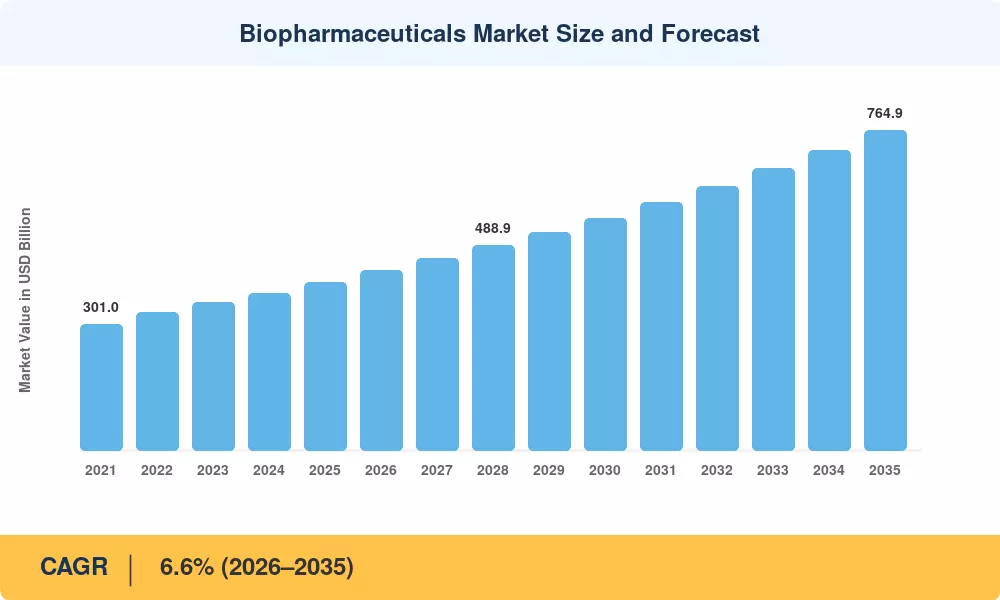
Biopharmaceuticals Market to Surge from USD 401.6 Billion in 2025 to USD 764.9 Billion by 2035—By Rising Chronic Disease Burden, Oncology Pipeline Density
NY, CA, UNITED STATES, September 2, 2026 /EINPresswire.com/ — As per Market Research Future, the global Biopharmaceuticals Market size is projected to reach USD 764.9 Billion by 2035 from USD 401.6 Billion in 2025, at a CAGR of 6.6% during the forecast period 2026–2035. The market base was estimated at USD 401.6 Billion in 2025, with the first year of the forecast period (2026) valued at USD 430.2 Billion.
The 6.6% CAGR is anchored by two major catalysts: the U.S. Inflation Reduction Act’s Medicare negotiation provisions, which reshaped pricing strategy for high-revenue biologics from 2026 onward, and the EU Pharmaceutical Package revision, which retooled regulatory data protection for advanced therapies. These policy shifts are occurring alongside a profound manufacturing transformation, as fixed stainless-steel fermentation suites give way to single-use bioreactor trains, continuous perfusion, and modular pod facilities that compress build timelines from roughly five years to under two.
Global pharmaceutical leaders and contract manufacturing organizations are amplifying this momentum. Lonza committed CHF 500 million to expanded biologics capacity in Visp, while Samsung Biologics brought Plant 5 online at 180,000 litres. Continuous downstream processing now cuts cost per gram of purified antibody by an estimated 30–40% versus legacy batch chromatography. Regionally, North America holds 40.5% of global revenue on the strength of FDA accelerated pathways and dense venture funding, while Asia-Pacific grows fastest at an 8.9% CAGR through 2035, powered by China’s NMPA reforms and India’s Production Linked Incentive scheme.
Request A Free Sample:
https://www.marketresearchfuture.com/sample_request/8439
Key Market Trends & Growth Drivers
Rising Chronic Disease Burden
Alzheimer’s disease accounts for 60–70% of dementia cases, which impact over 57 million individuals globally and result in nearly 10 million new diagnoses each year. Once anti-amyloid antibodies passed regulatory approval, that epidemiology immediately translated into commercial demand. Another layer is added by diabetes: the IDF Atlas counts 589 million adults with the condition; this demographic serves as the foundation for the biopharmaceuticals market’s sustained volume of incretin and insulin analogs.
Oncology Pipeline Density
Antibody-drug conjugates are the modality cluster with the quickest rate of growth among the approximately 2,300 cancer biologics currently undergoing clinical development. The USD 43 billion purchase of Seagen by Pfizer served as an example of how well-established companies purchase their way into conjugate chemistry rather than developing it. Approval throughput is just as important as pipeline size; in 2024, CDER approved 50 new medicines, a record percentage of which were biologics.
Manufacturing Capacity Expansion and CDMO Scale-Up
Global installed mammalian cell culture capacity passed 8.1 million litres, with Asia-Pacific contributing the largest incremental additions. Samsung Biologics’ Plant 5 alone added 180,000 litres, and its Bio Campus II programme carries a KRW 7.5 trillion commitment through 2032. Capacity abundance compresses tolling rates, which in turn lowers the entry barrier for mid-cap sponsors pursuing biologics drug development without owning bricks.
Regulatory Acceleration
EMA’s PRIME scheme has granted priority status to more than 100 candidates since inception, shaving an estimated 8–12 months off typical review timelines. FDA’s RMAT designation performs a parallel function for regenerative products, with over 130 designations granted. Speed to market compounds: each quarter of earlier launch is worth roughly 2–3% of a product’s lifetime net present value at prevailing discount rates.
Ask for Customization:
https://www.marketresearchfuture.com/ask_for_customize/8439
Market Segment Insights
BY PRODUCT TYPE
Monoclonal Antibodies: Dominant segment with 38.5% share in 2025, the single largest product concentration in the industry. Antibodies dominate because the modality is industrialised: expression titres above 5 g/L are routine, purification is templated, and regulatory precedent is deep.
Recombinant Hormones: Fastest-growing product type at 7.9% CAGR (2026–2035) , driven by GLP-1 and insulin analogue demand. Incretin analogues expanded from diabetes into obesity and cardiovascular risk reduction, adding indications faster than manufacturing capacity could follow.
Vaccines: Significant segment at USD 65.1 Billion in 2025, as routine immunisation budgets normalised post-pandemic.
Recombinant Proteins: Growing at 7.4% CAGR (2026–2035) , driven by haemophilia and rare disease indications.
BY THERAPEUTIC APPLICATION
Oncology: Largest application with 31.0% share in 2025, the dominant application across the Biopharmaceuticals Market. Oncology’s leadership rests on both price and volume: checkpoint inhibitors carry annualised costs above USD 150,000 and now hold approvals across more than 20 tumour types.
Metabolic Disorders: Fastest-growing application at 9.4% CAGR (2026–2035) , driven by obesity and type 2 diabetes prescribing. Moderate per-patient pricing against an enormous eligible population, with supply rather than demand as the binding constraint through at least 2027.
Autoimmune Disorders: Significant segment at USD 71.5 Billion in 2025, driven by IL-23 and JAK-adjacent biologic switching.
Inflammatory and Infectious Diseases: Significant segment at USD 90.4 Billion in 2025, driven by biologic disease-modifying therapy uptake.
BY END USER
Hospitals and Clinics: Largest segment with 52.8% share in 2025, driven by infusion infrastructure and specialist prescribing.
Homecare Settings: Fastest-growing end-user at 8.7% CAGR (2026–2035) , driven by autoinjector adoption and remote monitoring. Every conversion from intravenous infusion to subcutaneous autoinjector moves revenue out of hospital buy-and-bill and into pharmacy channels.
Specialty and Retail Pharmacies: Significant segment at USD 118.5 Billion in 2025, driven by self-administered subcutaneous formulations.
Read Detailed Insights:
https://www.marketresearchfuture.com/reports/biopharmaceuticals-market-8439
Regional Outlook
North America — Dominant Market (~40.5% Share, 2025)
United States: Generates approximately 86.4% of North American revenue, driven by FDA accelerated pathways and commercial payer breadth. FDA cleared 50 novel drugs in 2024, and the Cell and Gene Therapy Access Model launched by CMS created a state-level purchasing mechanism for sickle cell gene therapies priced above USD 2 million per patient.
Canada: Contributes USD 14.6 Billion, driven by pCPA joint negotiation and biosimilar switching policy.
Mexico: Fastest-growing in the region at 7.9% CAGR, driven by IMSS procurement reform and local fill-finish investment.
Europe — Second Largest (USD 104.4 Billion, 2025)
Germany: Holds 24.1% of regional share, driven by AMNOG benefit assessment and high biologic uptake.
United Kingdom: Contributes USD 17.9 Billion, driven by NICE appraisal reform and ILAP designation.
France: Fastest-growing in the region at 6.4% CAGR, driven by early access authorisation scheme.
Italy: Holds 9.6% of regional share, driven by AIFA tendering and regional procurement pools.
Spain: Contributes USD 7.5 Billion, driven by hospital-led biosimilar substitution.
Nordic Countries: Growing at 6.9% CAGR, driven by centralised tenders and registry infrastructure.
Russia: Holds 4.8% of regional share, driven by domestic substitution mandates.
Rest of Europe: Contributes USD 11.2 Billion, driven by accession-market access programmes.
Asia-Pacific — Fastest-Growing Region (8.9% CAGR, 2026–2035)
China: Contributes USD 31.4 Billion, driven by NMPA reform and provincial NRDL listing. The National Reimbursement Drug List added a record number of innovative biologics in its 2024 cycle, compressing the launch-to-reimbursement interval to under 14 months for priority products.
India: Fastest-growing in the region at 9.8% CAGR, driven by Production Linked Incentive and biosimilar exports.
Japan: Holds 21.3% of regional share, driven by ageing demographics and Sakigake designation.
South Korea: Contributes USD 9.1 Billion, driven by contract manufacturing capacity leadership.
ASEAN: Growing at 8.6% CAGR, driven by universal coverage expansion in Indonesia and Thailand.
South America — Growing Presence (5.2% Share, 2025)
Brazil: Anchors the region at 58.7% of revenue, driven by PDP technology transfer and SUS procurement. Productive Development Partnerships require originators to transfer manufacturing know-how to Fiocruz or Butantan in exchange for guaranteed public volume.
Argentina: Contributes USD 3.6 Billion, driven by domestic biotech base and regional exports.
Middle East & Africa — Emerging Opportunity (7.6% CAGR, 2026–2035)
Saudi Arabia: Contributes USD 4.1 Billion, driven by Vision 2030 localisation and NUPCO procurement.
UAE: Fastest-growing in the region at 8.4% CAGR, driven by insurance mandates and medical tourism.
South Africa: Holds 17.2% of regional share, driven by SAHPRA capacity and HIV therapeutic programmes.
Egypt: Contributes USD 1.9 Billion, driven by Universal Health Insurance rollout.
Competitive Landscape and Recent Developments
Concentration in the Biopharmaceuticals Market is high by pharmaceutical standards. The top five participants control an estimated 34–38% of revenue. Fragmentation increases sharply below the top twenty, where several hundred clinical-stage sponsors compete for licensing partners rather than direct commercial share.
KEY COMPANIES AND RECENT MILESTONES
Roche: Companion-diagnostic integration leader with oncology antibodies, conjugates, and diagnostics pairing. Estimated ~8–11% revenue share.
Johnson & Johnson: Broad-modality innovator with deep immunology base. Immunology, oncology bispecifics, and vaccines. Estimated ~7–9% revenue share.
Merck & Co.: Single-franchise concentration with checkpoint inhibitors and HPV vaccines. Estimated ~6–8% revenue share.
AbbVie: Post-LOE portfolio rebuild via bolt-on M&A. Immunology biologics, neurotoxins, and conjugates. Estimated ~5–7% revenue share.
Pfizer: Scale manufacturing plus large-cap acquisition strategy. Vaccines, conjugates, and rare disease biologics. Estimated ~5–7% revenue share.
Novo Nordisk (June 2024): Committed USD 4.1 billion to a North Carolina fill-finish facility to relieve incretin supply constraints, with production ramping from 2027. Estimated ~4–6% revenue share.
Sanofi: Vaccine and immunology dual anchor. Estimated ~4–6% revenue share.
Amgen: Integrated originator and biosimilar operator. Antibodies, biosimilars, and bone health. Estimated ~4–6% revenue share.
Novartis: Modality-diverse with strong gene therapy assets. Radioligand therapy, cell therapy, and immunology. Estimated ~4–6% revenue share.
AstraZeneca: Conjugate partnership depth via Daiichi alliance. Oncology conjugates and respiratory biologics. Estimated ~3–5% revenue share.
Eli Lilly: Neurology and metabolic growth leader. Incretins and anti-amyloid antibodies. Estimated ~3–5% revenue share.
Bristol Myers Squibb: Cell therapy commercialisation focus. Immuno-oncology and cell therapy. Estimated ~3–5% revenue share.
Recent Industry Developments:
CMS (August 2024): Published negotiated Medicare prices for the first ten selected drugs, with reductions of 38–79% versus 2023 list prices, effective January 2026.
European Commission (April 2023): Proposed the Pharmaceutical Package revision, restructuring regulatory data protection and introducing transferable exclusivity vouchers for priority antimicrobials.
India Department of Pharmaceuticals (September 2024): Expanded PLI disbursements toward fermentation-based intermediates and biologics, reinforcing import-substitution targets.
Future Outlook: 2026–2035
The Biopharmaceuticals Market is projected to reach USD 764.9 Billion by 2035, growing at a CAGR of 6.6%, driven by rising chronic disease burden, oncology pipeline density, and manufacturing capacity expansion.
New opportunities lie in:
Computational Discovery Becomes Standard Practice: AI-designed candidates entered clinical testing in meaningful numbers by 2025, and structure prediction tools have collapsed target validation timelines from years to weeks.
Platform Economics and Modality Consolidation: Sponsors are consolidating around fewer, deeper technology platforms—one antibody scaffold, one conjugation chemistry, one delivery system—reused across indications.
Supply Chain Regionalisation: Geopolitical exposure reshaped sourcing strategy after the U.S. BIOSECURE legislative push targeted specified Chinese service providers. Dual-sourcing of drug substance is becoming a board-level requirement.
Value-Based Contracting and Outcomes Reporting: Payers are shifting risk onto manufacturers through outcomes-linked rebates, particularly for one-time therapies priced above USD 1 million.
Emerging-Market Access Expansion: India’s PLI scheme allocated about INR 150 billion for high-value biologics, while Brazil’s PDP partnership model links local technology transfer to public procurement.
By 2035, the Biopharmaceuticals Market is expected to demonstrate robust growth, reflecting evolving therapeutic modalities, manufacturing innovation, and expanding global access to biologic therapies.
More Related Research Insights:
https://www.marketresearchfuture.com/ja/reports/ayurveda-market-6166
https://www.marketresearchfuture.com/ja/reports/beauty-devices-market-562
https://www.marketresearchfuture.com/ja/reports/biosensor-market-1228
https://www.marketresearchfuture.com/ja/reports/body-contouring-market-1343
https://www.marketresearchfuture.com/ja/reports/capsule-endoscopy-market-1359
https://www.marketresearchfuture.com/ja/reports/chemotherapy-market-5791
https://www.marketresearchfuture.com/ja/reports/cosmetic-surgery-market-3157
https://www.marketresearchfuture.com/ja/reports/dental-prosthetics-market-2905
https://www.marketresearchfuture.com/ja/reports/diabetes-drug-market-1160
https://www.marketresearchfuture.com/ja/reports/diabetic-nephropathy-market-5664
https://www.marketresearchfuture.com/ja/reports/dry-eye-syndrome-market-5588
https://www.marketresearchfuture.com/ja/reports/emergency-medical-services-market-8363
Market Research Future
Market Research Future
+1 855-661-4441
email us here
Legal Disclaimer:
EIN Presswire provides this news content “as is” without warranty of any kind. We do not accept any responsibility or liability
for the accuracy, content, images, videos, licenses, completeness, legality, or reliability of the information contained in this
article. If you have any complaints or copyright issues related to this article, kindly contact the author above.

Media gallery