
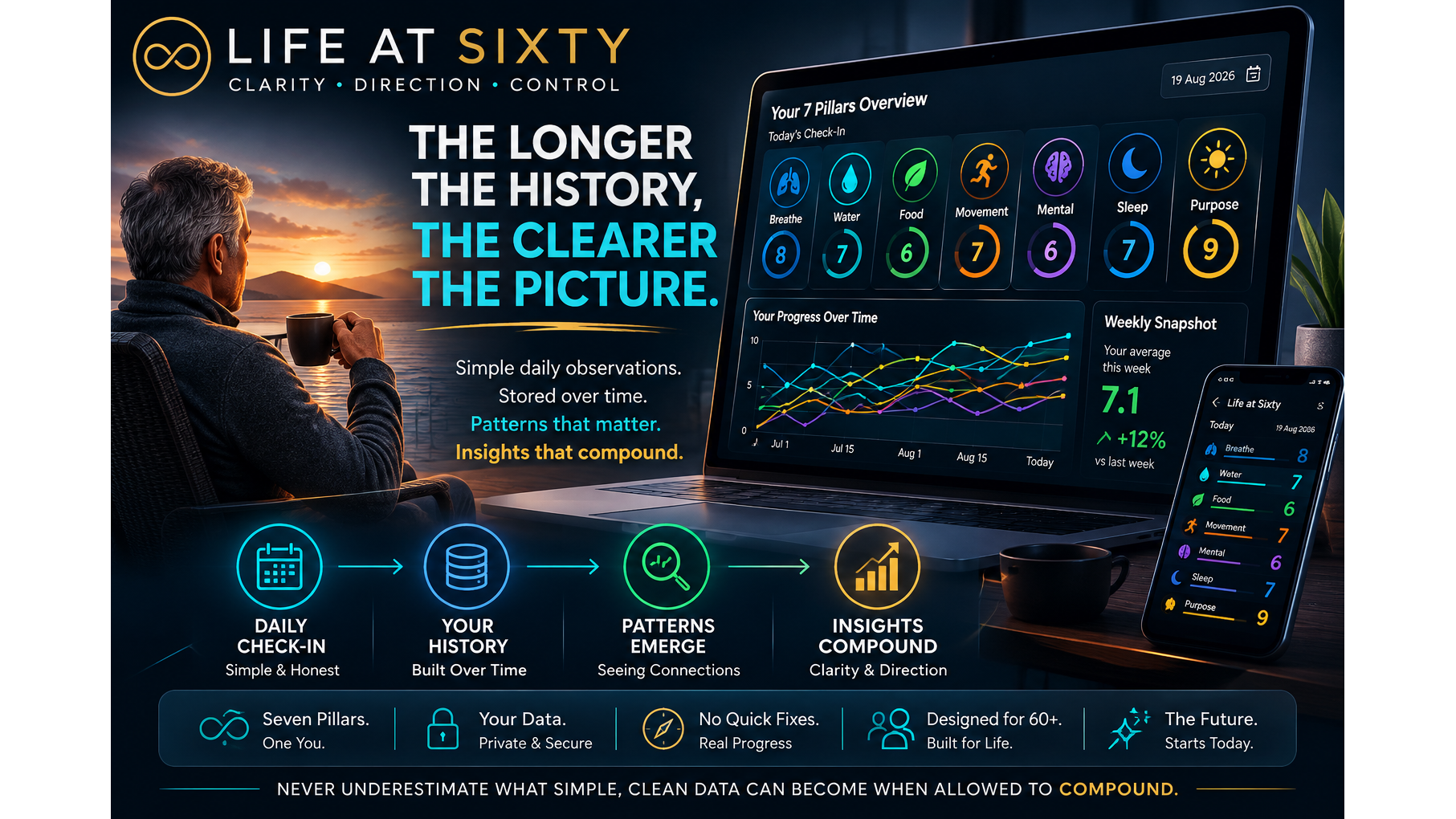
The Longer the History, the Clearer the Picture: How Personal Patterns Can Emerge After 60
Life after 60 brings an unusual advantage: decades of lived experience. Yet much of that experience exists as memory rather than information that can be observed over time.
A difficult week may be remembered. A particularly good month may stand out. What is harder to recognise are the smaller relationships between sleep, movement, mental wellbeing, purpose, daily habits and the circumstances surrounding them.
Life at Sixty is developing a different approach based on a straightforward principle:
The longer the history, the clearer the picture.
Rather than attempting to understand an individual through a single questionnaire or assessment, the Life at Sixty Seven Pillar system begins with simple observations recorded consistently over time.
More information about Life at Sixty is available at Life at Sixty.
Seven Simple Signals
The system is organised around seven areas:
Breathe, Water, Food, Movement, Mental Wellness, Sleep, and Spirituality & Purpose.
Each check-in provides a snapshot of how those areas feel to the individual at that particular point in time.
There is deliberately no universal definition of a perfect score.
A six for one person does not necessarily represent the same experience as a six for somebody else. What matters is how an individual’s scores behave relative to that individual’s own history.
That distinction becomes increasingly important as information accumulates.
One Check-In Is Only a Snapshot
A single check-in can answer a basic question:
Where do things stand today?
Useful, but limited.
Repeated observations begin answering different questions.
What has changed?
What remains consistently strong?
What repeatedly needs attention?
Does one area appear to move alongside another?
Do certain circumstances regularly coincide with better or more difficult periods?
These questions cannot be answered reliably from one observation.
They require history.
This is why Life at Sixty treats the daily check-in as the beginning of the process rather than the finished product.
Building a Personal History
Over time, individual observations begin forming a personal longitudinal record.
Optional notes can add another layer of context. Work demands, travel, family events, unusual sleep, exercise, stress or simply having an exceptionally good day may help provide context around changing scores.
The objective is not to record every detail of life.
It is to preserve enough honest information that changes and relationships have an opportunity to become visible.
Historical integrity therefore matters.
A missed day does not need to be invented simply to create a complete-looking record. Where a past day can genuinely be recalled, it can be recorded later. Otherwise, missing information can simply remain missing.
Completed observations form part of the historical scorecard.
The quality of future insight depends heavily on the quality of the information underneath it.
When History Starts Becoming More Valuable
Early in the process, there may be very little to analyse.
That is expected.
The system does not need to pretend that several days of information reveal profound truths about decades of life.
As weeks become months, however, repeated observations create more context. Patterns may begin emerging. With sufficient history, relationships between different pillars and circumstances may become increasingly useful to examine.
The progression is deliberately gradual:
Observe → Recognise → Understand → Compound.
At first, the objective is simply to observe.
With sufficient repetition, recurring patterns may become recognisable.
As the historical record grows, those patterns can potentially be understood in greater context.
Eventually, accumulated history creates the foundation for what Life at Sixty calls Compounding Intelligence.
What Is Compounding Intelligence?
Compounding Intelligence is the longer-term development philosophy behind the Life at Sixty system.
It does not mean that the current dashboard can predict outcomes or instantly understand an individual’s life.
The concept is considerably simpler.
An individual observation contains limited information. A sequence of honest observations contains more. When that sequence becomes sufficiently substantial, relationships may become visible that could never have been identified from the first observation alone.
Consider the difference between a photograph and a film.
A photograph captures a moment.
A film reveals movement.
Personal history can work in a similar way.
The longer-term objective is for Life at Sixty to become increasingly useful because the system has accumulated more of the individual’s own history to work with — rather than because it makes increasingly broad assumptions about that individual.
Simplicity Matters
There is an obvious temptation when developing technology to keep adding features to the main interface.
Life at Sixty is taking the opposite approach.
The daily dashboard is intended to remain simple.
Record the Seven Pillars. Consider what needs attention. Add context when useful. Continue with the day.
Deeper capabilities such as history, pattern recognition and future Compounding Intelligence can develop around that simple core rather than overwhelming it.
This matters because a sophisticated system that becomes irritating to use will struggle to build meaningful longitudinal information.
The daily action needs to remain sustainable.
Understanding Must Be Earned
Perhaps the most important principle behind the system is that Life at Sixty does not need to claim complete understanding from the beginning.
Understanding should be earned.
Day after day, the individual provides the observations. Over time, those observations form history. History creates the opportunity to recognise patterns. Patterns may eventually create better personal insight.
The individual remains the source.
The technology helps organise what accumulates.
That creates a fundamentally different relationship between the member and the system.
The objective is not simply to produce another daily score.
It is to gradually build something that did not exist on the first day: a personal body of evidence.
And that leads back to the principle at the centre of the project:
Never underestimate what simple, clean data can become when allowed to compound.
For more information, visit Life at Sixty.
Life at Sixty
+61 412 356 702
Gayton Rd, City Beach
Perth
Western Australia
6015
Australia


