
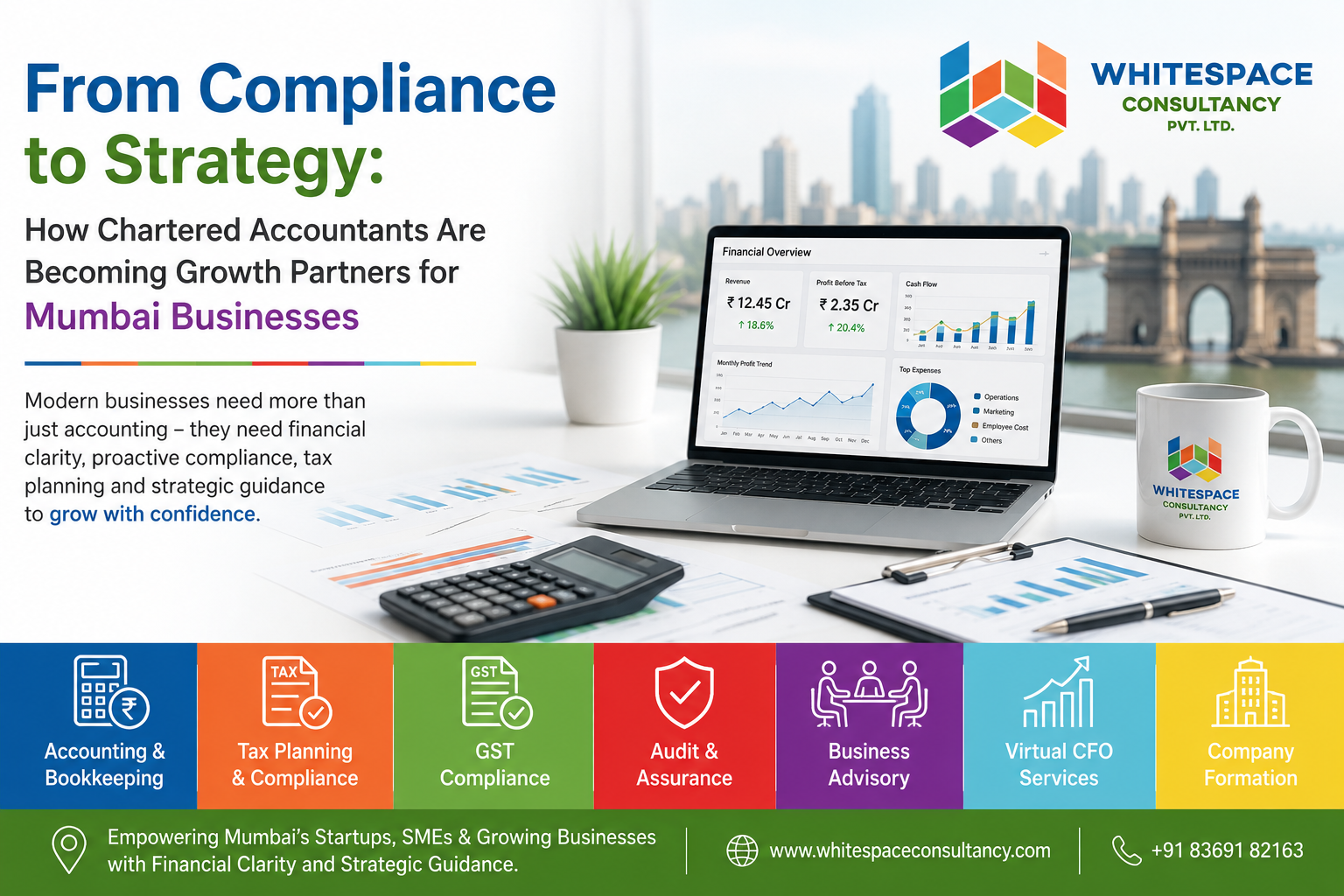
Mumbai, Maharashtra Aug 17, 2026 (Issuewire.com) The role of Chartered Accountants is evolving as businesses increasingly seek financial guidance that extends beyond routine bookkeeping, tax filing and statutory compliance. For startups, small and medium-sized enterprises and growing businesses in Mumbai, accounting and taxation are increasingly being viewed as part of a broader financial management strategy.
Traditionally, businesses often engaged a Chartered Accountant primarily for annual tax filing, audit requirements or statutory compliance. While these responsibilities remain essential, the financial needs of growing businesses have become considerably more complex.
Business owners today need timely financial information, stronger internal controls, cash-flow visibility, tax planning, GST compliance, management reporting and financial guidance to support important decisions.
This shift is creating a broader role for Chartered Accountants from compliance professionals to long-term financial and business advisors.
From Annual Compliance to Continuous Financial Management
For many businesses, financial management used to follow a relatively simple cycle:
Accounting Services Tax Filing Annual Compliance
The modern business environment increasingly requires a more continuous approach:
Accounting GST & Tax Compliance Financial Reporting Cash-Flow Management Tax Planning Business Advisory Strategic Financial Support
Monthly and quarterly financial reviews can help business owners understand not only how much revenue the business generated, but also where cash is being used, which costs are increasing, how receivables are performing and whether the business is financially prepared for its next stage of growth.
This is particularly relevant for businesses experiencing rapid growth, entering new markets, adding employees, raising external capital or managing increasingly complex regulatory requirements.
Why Mumbai Businesses Need More Than Routine Accounting
Mumbai’s diverse business ecosystem includes startups, professional service firms, manufacturers, retailers, technology companies, healthcare businesses, real estate businesses and established promoter-led enterprises.
Each business can have different financial requirements.
A startup may need help establishing its accounting systems, understanding tax and GST requirements and preparing reliable financial information from the beginning.
An SME may need monthly accounting, GST reconciliation, TDS compliance, Income Tax planning and management reporting.
An established company may require audit support, financial analysis, tax planning, due diligence, internal controls and strategic financial advisory.
As businesses grow, the financial function therefore needs to evolve with them.
The Rise of Advisory-Led Accounting
One of the most important changes is the movement from transactional accounting to advisory-led financial management.
Accurate bookkeeping remains the foundation, but businesses increasingly want financial information that can support decision-making.
For example, a monthly financial review can help management identify:
- Changes in profitability
- Increasing operating costs
- Receivables and collection issues
- Working-capital requirements
- Cash-flow pressure
- Tax liabilities
- Business performance trends
This enables the finance function to move beyond simply recording what happened.
The objective becomes understanding why it happened and what the business should consider doing next.
Tax Planning Is Becoming More Proactive
Tax compliance continues to be a major responsibility for businesses, but tax planning is increasingly becoming a year-round activity.
Instead of reviewing tax positions only before filing returns, businesses can benefit from considering the tax implications of significant decisions in advance.
These may include:
- Business expansion
- New investments
- Changes in business structure
- Capital expenditure
- Transactions between related parties
- Hiring and compensation decisions
- Cross-border transactions
Professional tax planning must always operate within applicable laws and regulations, but proactive advice can help businesses make better-informed financial decisions.
GST and Compliance Require Ongoing Attention
The expansion of India’s indirect tax framework has also increased the importance of consistent GST processes.
Businesses may need to manage:
- GST registration
- Return filing
- Input Tax Credit reconciliation
- Invoice documentation
- Tax classifications
- Reverse Charge Mechanism requirements
- Compliance reviews
- GST notices
For businesses with high transaction volumes or multiple registrations, maintaining accurate records and performing regular reconciliations can become increasingly important.
A structured accounting and compliance process can help identify discrepancies before they develop into larger issues.
Virtual CFO Services Are Expanding Beyond Large Companies
Another development in the financial services landscape is the growing interest in Virtual CFO support.
Historically, CFO-level financial management was largely associated with larger organisations that could justify maintaining a dedicated senior finance executive.
Startups and SMEs may now access similar strategic financial capabilities through an outsourced or Virtual CFO model.
Depending on the engagement, Virtual CFO support can involve:
- Financial planning
- Budgeting
- Cash-flow forecasting
- Management reporting
- Financial analysis
- Business planning
- Investor reporting
- Performance monitoring
- Strategic financial guidance
This allows growing businesses to access senior financial expertise without necessarily building a large internal finance function.
The Importance of Partner-Led Financial Advice
As the scope of financial management expands, businesses are also paying closer attention to who is actually involved in their financial decisions.
A strong professional relationship can involve:
Acounting Team Compliance Review Chartered Accountant Business Advisory
This structure allows routine accounting and compliance activities to be supported by appropriate processes while complex matters receive senior professional attention.
For business owners, the objective is not simply to outsource accounting.
It is to create a financial system that provides reliable information and professional guidance when important decisions need to be made.
Whitespace Consultancy’s Approach
Whitespace Consultancy is a partner-led Chartered Accountant firm in Mumbai supporting startups, SMEs, professionals and established businesses across accounting, taxation, GST, audit, compliance and business advisory.
The firm works with businesses that are looking to strengthen their financial systems, improve reporting and manage increasing financial and regulatory complexity.
Its approach combines accounting and compliance with broader financial advisory, helping businesses move from reactive financial management towards more structured and proactive decision-making.
Whitespace Consultancy’s services include accounting and bookkeeping, Income Tax services, GST registration and compliance, audit and assurance services, business formation support, financial reporting, business advisory and Virtual CFO services.
The firm also works with businesses across Mumbai and nearby business locations including Mulund, Bhandup, Powai, Ghatkopar, Vikhroli, Thane and Navi Mumbai.
What Businesses Should Look for in a Modern CA Firm
As the role of Chartered Accountants continues to evolve, businesses should evaluate professional advisors based on more than their compliance fees.
Important considerations include:
- Relevant industry experience
- Accounting capabilities
- GST and taxation expertise
- Audit and compliance knowledge
- Financial reporting
- Technology and accounting systems
- Communication processes
- Senior professional involvement
- Tax planning capabilities
- Business advisory experience
- Scalability as the business grows
The right financial partner should be capable of supporting the business at its current stage while also adapting as its financial requirements become more complex.
The Future of Business Accounting
The distinction between accounting, compliance and financial advisory is becoming less rigid for many growing businesses.
Accurate accounts remain essential, but businesses increasingly expect financial professionals to help them understand their numbers, manage risks, improve financial visibility and plan for future growth.
For startups and SMEs in particular, this can mean moving from:
“Are our accounts and returns up to date?”
to:
“What are our numbers telling us about the business, and what should we do next?”
That shift represents the broader evolution of the Chartered Accountant’s role from a professional primarily associated with compliance to a potential long-term financial partner for business growth.
Media Contact
Whitespace Consultancy Media Team
info@whitespaceconsultancy.com
+91 83691 82163
825, Ecstasy Business Park, City of Joy, JSD Road, Mulund West
Source :Whitespace Consultancy
This article was originally published by IssueWire. Read the original article here.


